A fully responsive site template designed by HTML5 UP and released
for free under the Creative Commons license.
Stages
The Steps in Game Creation
Video game development is a complex and structured process that requires careful planning, creativity, and technical expertise. From small indie titles to massive AAA productions, every game follow a development cycle to ensure
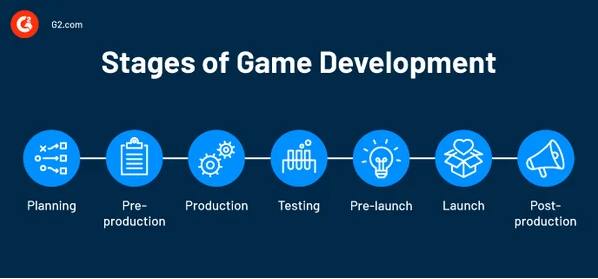
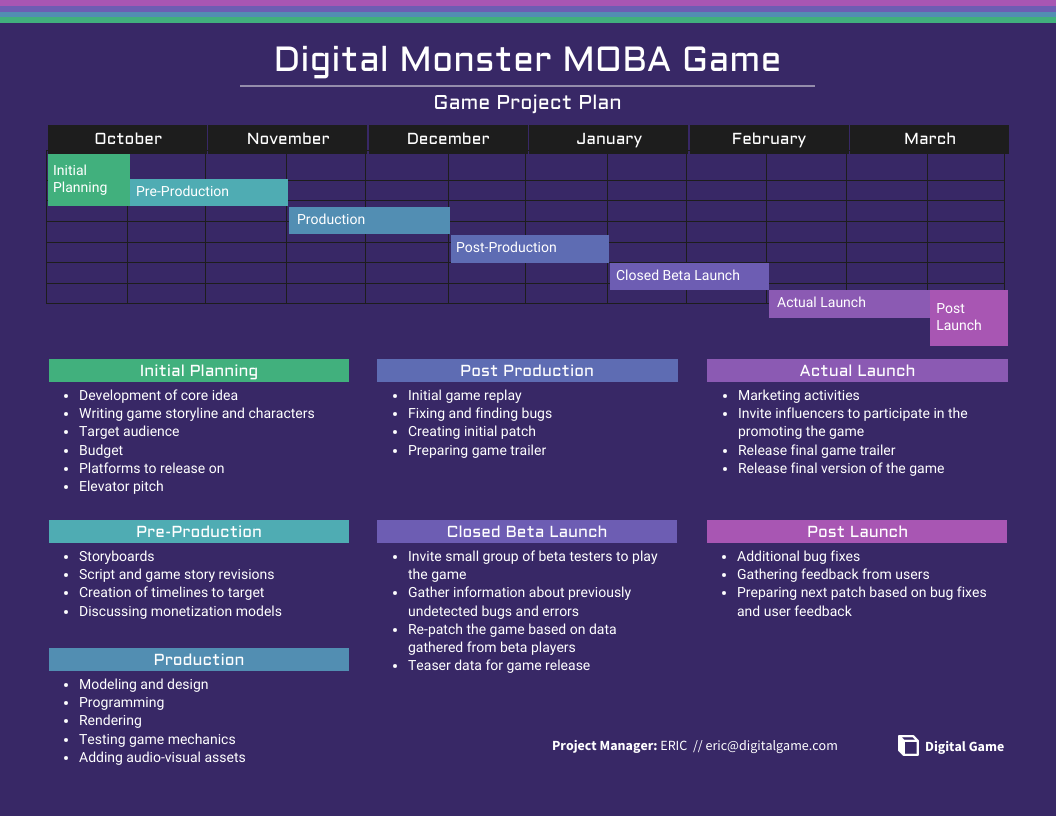
a polished and engaging experience for players. The process consists of seven key stages, Planning, Pre-production, Production, Testing, Pre-Launch, Launch, and Post-Production. Planning involves
defining the games concept, targets audicence, and viability. Pre-production focuses on design documents, concept art, and selecting the necessary tools and technologies. During production, developers build the core mechanics, graphics,
animations, and sound design, bringing the game to life. Testing is essential for identifying bugs, balancing gameplay, and optimizing performance. In the pre-launch phase, marketing campaigns and final refinements prepare the game for release.
The Launch stage marks the official release, with developers monitoring player feedback and fixing any emerging issues. Post-production involves updates, patches, and additional content to keep players engaged and improve the overall experience.
Without a structured process, games risk technical failures, poor design, or lack of market appeal. Careful execution across all stages ensures a game meets industry standards and provides a seamless, enjoyable experience for players.
This website will dive into the Planning, production,Testing, and launch phases, highlighting their key components and their impact on a games success. Wether you're an aspiring developer or a passionate gamer, understanding these stages provides valuable insight
into the effort behind every game. Game development requires a blend of technical expertise, creative vision, and project management. A well structured workflow reduces production delays, improves efficiency, and ensures a polished final product.
Each phase plays a cruical role in shaping the gameplay, mechanics, and overall player experience. By exploring these essential stages, you'll gain a deeper appreciation for the challenges and dedication involved in bringing a game to life. Let's
dive into the journey from concept to Launch.
Planning
Defining the Game Concept
The planning phase is the cornerstone of game development, ensuring that the project starts with a strong foundation. Without a clear and structured plan, game development can quickly become chaotic, leading to delays, budget overruns, and even project failure.
During this phase, the development team brainstorms ideas, researches the market, and assesses the viability of their concept. Developers must consider factors such as audience demand, technical limitations, and financial constraints. The planning involves game ideation,
concept proofing, and financial assessment, all of which help shape the project's direction. A well-defined plan not only provides clarity but also minimizes risks, ensuring a smoother workflow in later stages of development. A poorly planned project may face unexpected obstacles,
causing disruptions that can delay or even halt production entirely. By carefully outlining goals, identifying potential challenges, and setting realistic expectations, developers create a roadmap that guides the entire team. With a strong planning phase, the game has a much higher chance of success,
as developers can anticipate difficulties and make informed decisions before production begins.
In game ideation, the team determines the core aspects of their game, such as its genre, target audience, platform, and gameplay mechanics. Developers must establish whether the game will be single-player or multiplayer, what makes it unique, and how it will stand out from competitors. Once a concept is chosen,
the next step is concept proofing, where developers conduct a viability study to evaluate whether the project is viable. This includes analyzing budget constraints, production timelines, and monetization strategies to ensure the game can be developed within available resources. If a game is too ambitious for the budget
or requires technology that isn't accessible, adjustments must be made before moving forward. Developers also assess potential revenue models, such as one-time purchases, in-game transactions, or subscription services. A well-executed concept proofing phase prevents costly mistakes, ensuring that the game is both financially
and technically feasible. By addressing these factors early on, teams can avoid setbacks and build a solid foundation for the rest of the development process.
Production Phase
Bringing the Game to Life
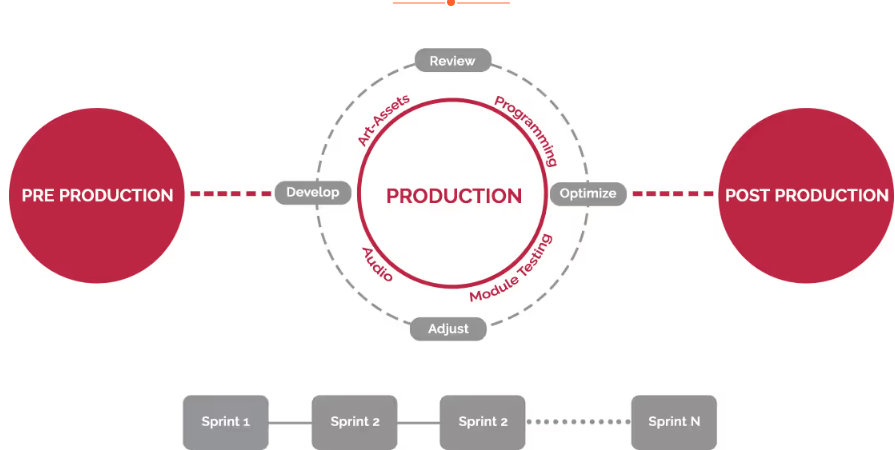
The production phase is where the core game takes shape, making it the longest and most demanding stage of development. This phase requires a collaborative effort between programmers, artists, designers, and sound engineers, all working together
to bring the game to life. Developers focus on coding the game's core systems, including player movement, enemy AI, physics, animations, and user interface elements. Artists create 3D models, textures, and environmental assets, while sound designers compose
music and sound effects to enhance immersion. Writers also contribute by developing scripts for cutscenes, dialogues, and interactive storytelling. Every aspect must function seamlessly to create a cohesive and engaging experience for players.
One of the biggest challenges in this phase is maintaining optimization and performance stability. As new assets and mechanics are introduced, they must be tested to prevent issues such as frame rate drops, crashes, or input lag. Developers rely on engines like Unity
and Unreal Engine, which offer built-in tools for animation, physics simulation, and level design. Iteration is a crucial part of this phase; many mechanics go through multiple revisions to improve player experience and eliminate unforeseen problems. Poor optimization can negatively
impact reviews and player reception, making performance testing a top priority. The production phase continues until all major gameplay systems and assets are implemented, ensuring the game is fully playable before entering the next stage.
The level design process is a critical component of production, defining how players interact with the game world. Designers carefully construct maps, obstacles, and enemy placements to create a balanced challenge suited to the game’s genre and target audience expectations. In open-world games,
this involves crafting expansive environments filled with interactive NPCs, explorable locations, and dynamic events that make the world feel alive. In more linear games, levels must be structured to provide progressive difficulty, engaging encounters, and a natural gameplay flow that keeps players invested.
Game mechanics such as combat systems, puzzles, or AI behaviors must also be fine-tuned to ensure a smooth, immersive, and enjoyable experience for all players.
Throughout production, playtesting plays a crucial role in refining mechanics and identifying issues. Internal testers and developers evaluate the game to uncover unintended exploits, balancing problems, and frustrating mechanics that could negatively impact the player experience. This iterative feedback loop allows
developers to refine features, ensuring they align with the original creative vision and gameplay goals. If a mechanic doesn't work as expected, it may be reworked, adjusted, or even be removed entirely. By the end of the production phase, the game should be fully playable, with all core mechanics, assets, and levels
seamlessly integrated and optimized in preparation for the next stage: testing and final refinements before launch.
Here is an example of a soundtrack from the game Celeste.
Testing Phase
Ensuring Game Quality
The testing phase is one of the most crucial steps in game development, ensuring that the final product is polished and free of major issues. Before a game is officially released, it undergoes rigorous testing to identify and resolve bugs,
glitches, and performance problems that could negatively impact the player experience. Developers conduct various testing methods, including Quality Assurance (QA) testing, playtesting, and automated testing, to check for technical errors and gameplay imbalances.
Without a thorough testing process, games risk launching with game-breaking bugs, poor optimization, or broken mechanics, which can lead to bad reviews, low player retention, and potential failure in the market.
Multiple types of testing occur during this phase to ensure every aspect of the game functions as intended. Unit testing verifies that each individual feature, such as character movement, combat mechanics, and inventory systems, operates correctly. Integration
testing examines how different game systems interact, including AI behavior, sound effects, and UI elements. Regression testing is conducted after updates to ensure previously working features have not been unintentionally broken. Performance testing evaluates frame rates,
loading times, and overall stability across different hardware configurations, helping to prevent technical issues at launch. Many developers also conduct closed beta tests or public playtests, allowing real players to provide feedback on gameplay balance, controls, and overall
experience before the full release. These steps are essential in refining the game and ensuring a smooth, enjoyable experience for players.
Bringing the game to Players
Once testing is complete, the launch phase begins, marking the official release of the game to the public. This stage involves game distribution, final bug fixes, and marketing strategies to maximize visibility and player engagement. Developers release their games on major
platforms such as Steam, PlayStation Store, Xbox Marketplace, and mobile app stores, ensuring accessibility to a broad audience worldwide across different gaming communities and demographics. A strong pre-launch strategy is vital for building excitement and anticipation. Companies use a variety
of promotional tactics, including game trailers, demo versions, early access programs, influencer marketing, community engagement, and social media campaigns to create buzz and drive interest.
Before launch, developers must also ensure that the game meets the certification requirements of each platform. Console games, for example, must pass strict quality checks conducted by Sony, Microsoft, or Nintendo before being approved for their respective stores. On PC, developers work
to optimize performance across various hardware setups and ensure compatibility with major operating systems. A poorly planned launch can lead to negative player reception, mass refunds, or disappointing sales figures, so studios carefully monitor the rollout and prepare to release immediate patches if needed.
By executing a well-planned launch strategy, developers increase their chances of delivering a successful, well-received game to players worldwide.
This is bold and this is strong. This is italic and this is emphasized.
This is superscript text and this is subscript text.
This is underlined and this is code: for (;;) { ... }. Finally, this is a link.
Heading Level 2
Heading Level 3
Heading Level 4
Heading Level 5
Heading Level 6
Blockquote
Fringilla nisl. Donec accumsan interdum nisi, quis tincidunt felis sagittis eget tempus euismod. Vestibulum ante ipsum primis in faucibus vestibulum. Blandit adipiscing eu felis iaculis volutpat ac adipiscing accumsan faucibus. Vestibulum ante ipsum primis in faucibus lorem ipsum dolor sit amet nullam adipiscing eu felis.
Preformatted
i = 0;

while (!deck.isInOrder()) {
    print 'Iteration ' + i;
    deck.shuffle();
    i++;
}

print 'It took ' + i + ' iterations to sort the deck.';